A silver-paste trace can pass every outgoing inspection and still short out two years later in the field. Bell Labs spelled out the mechanism behind this delayed failure in 1955. This page compresses the physics, the numbers, and five suppression routes into one read, with a citation behind every figure.
|
Key takeaways |
|
Water is a precondition. The original definition lists adsorbed water on the insulation surface as a premise; without a continuous water film, migration does not proceed (Kohman et al. 1115). |
|
The acceleration is quantifiable. Thirty days at 130 V and 90% RH reproduced the amount of silver transferred in four years of field service (Kohman et al. 1115). |
|
Alloying has a threshold. In Ag-Pd films, dendrite growth stops completely at 30% Pd; the mechanism is anodic PdO passivation (Lin and Chan 256). |
|
Coatings are not insurance. A 20 μm parylene sample with 0.4 mm spacing shorted in about 2 minutes at 85 °C / 85% RH and 500 VDC (Shen and Reiderman 340). |
What silver migration is
- In 1955, three researchers at Bell Telephone Laboratories defined silver migration as a process in which silver in contact with an insulating material is removed ionically from its original location under an electrical potential and redeposited as metal elsewhere. The authors stated that the process requires adsorbed water on the insulation surface, and that silver is unique in this respect because it oxidizes and reduces easily and does not passivate (Kohman et al. 1115).
- The redeposition takes two forms: dendrites, which usually grow from the cathode toward the anode, and colloidal deposits near the anode. Both forms lower insulation resistance, and severe cases end in dielectric failure (Kohman et al. 1115).
Mechanism and accelerating factors
Electrochemical migration proceeds through four basic steps: path formation, anodic dissolution, ion migration, and metal-ion deposition. Moisture, ionic pollutants, bias conditions, conductor spacing, and electrolyte chemistry all significantly change migration behavior (Liao et al. 13001).
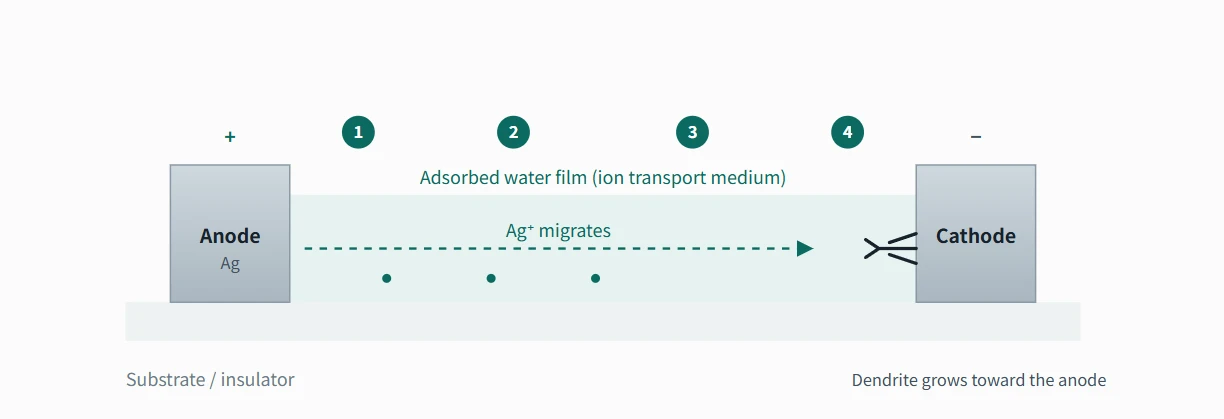
Figure 1 ① Water film forms ② Silver dissolves at the anode ③ Ions migrate through the film ④ Ions deposit at the cathode and grow into dendrites. Step breakdown follows Liao et al.; deposit morphologies follow Kohman et al.
Kohman and coauthors also left a useful acceleration rule. They found that thirty days at 130 V and 90% relative humidity reproduced the amount of silver transferred into the insulator during four years of service (Kohman et al. 1115).
|
Often overlooked Silver also migrates in hot, dry air. Li and coauthors point out that earlier work focused on humid room-temperature conditions, and that the mechanisms valid there no longer apply at high temperature. The finding matters most for wide-bandgap power packaging (Li et al. 154587). |
How to verify it: standard conditions and method differences
Table 1 Test conditions of IPC-TM-650 method 2.6.14 (IPC-B-25A comb patterns) rgb(244, 247, 250)
|
Parameter |
Class T |
Class H |
|
Temperature |
85 ± 2 °C |
85 ± 2 °C |
|
Relative humidity |
≥ 85% |
90% (+5 / −0%) |
|
Bias |
10 VDC |
10 VDC |
|
Duration |
500 hours |
168 hours |
Among the three classic methods (water drop, temperature-humidity-bias, and thin electrolyte layer), the THB method measures a migration rate roughly one ten-thousandth of the water-drop rate, so lifetimes from different methods must not be converted directly (Liao et al. 13001). On the failure-analysis side, Fan and coauthors identified silver acetate as the discoloration compound of PV snail trails using confocal micro-Raman spectroscopy without destroying the sample (Fan et al. 80).
Suppression routes: five paths with measured data
Table 2 Five suppression routes and the literature behind them
|
Route |
Key measured result |
Cost / boundary |
Source |
|
① Ag-Pd alloying |
Dendrites shrink as Pd rises from 5% to 20% and stop completely at 30%; anodic PdO blocks silver dissolution |
Bond strength down about 36% and thermal performance down about 6%; Pd costs about 15× Ag |
Lin and Chan 256; Li et al. 154587 |
|
② SiOx doping |
0.2% SiOx extends lifetime about 2.6× versus pure sintered Ag at 400 °C / 200 V, with almost no loss in mechanical, thermal, or electrical performance |
Costs about 1/300 of palladium |
Li et al. 154587 |
|
③ Equipotential and spacing design |
Grounding a metal separator removes the potential difference and blocks through-migration into the insulator |
Changes the field, not the materials |
Kohman et al. 1115 |
|
④ Cleaning and ionic control |
Ionic contamination trapped under coatings was proposed as one cause of rapid failure; substrate cleaning and pre-coating treatment were named critical factors |
Cleanliness must be verified before coating |
Shen and Reiderman 341 |
|
⑤ Coatings and encapsulation |
Counterexample: 20 μm Parylene HT over 0.4 mm-spaced sintered silver traces shorted in about 2 minutes at 85 °C / 85% RH and 500 VDC |
Works only with a clean interface, complete coverage, and sufficient thickness |
Shen and Reiderman 340 |
Engineering checklist
- Does the circuit carry a long-term unipolar DC bias? If yes, prefer equipotential design over material substitution (Kohman et al. 1115).
- Do the minimum spacing and maximum potential difference between adjacent silver traces have matching accelerated-test data (Liao et al. 13001)?
- Assess ionic contamination after cleaning and before coating (Shen and Reiderman 341).
- Verify that a coating exists and that the coating works as two separate questions (Shen and Reiderman 340).
- Assess high-temperature migration risk separately; do not extrapolate room-temperature humid results (Li et al. 154587).
FAQ
Q: What conditions must coexist for silver migration to occur?
A: The original definition lists adsorbed water on the insulation surface as a premise (Kohman et al. 1115), and the four-step mechanism also requires a continuous conductive path first (Liao et al. 13001). A water film, a DC field, and a dissolvable silver anode must all be present at the same time.
Q: Can conformal coatings or parylene fully block silver migration?
A: No. Sintered silver traces spaced 0.4 mm apart and covered with a 20 μm Parylene HT film shorted in about 2 minutes at 85 °C, 85% RH, and 500 VDC (Shen and Reiderman 340). A coating works only with a clean interface, complete coverage, and sufficient thickness.
Q: How should accelerated tests be set up?
A: IPC-TM-650 method 2.6.14 defines Class T as 85 ± 2 °C, at least 85% RH, 10 VDC, for 500 hours, and Class H as 90% RH for 168 hours (IPC 2.6.14). Migration rates measured by different methods differ by roughly four orders of magnitude (Liao et al. 13001), so lifetimes from different methods must not be converted directly.
Q: Need a migration risk review for a specific layout?
A: Send us your substrate, paste system, minimum spacing, and maximum DC potential difference. We will design a verification plan against IPC-TM-650 2.6.14 conditions.
References
- Fan, Jing, et al. "Study on Snail Trail Formation in PV Module through Modeling and Accelerated Aging Tests." Solar Energy Materials and Solar Cells, vol. 164, 2017, pp. 80–86.
- IPC. "Solder Mask – Resistance to Electrochemical Migration." IPC-TM-650 Test Methods Manual, method 2.6.14, rev. D, IPC, 2007.
- Kohman, G. T., et al. "Silver Migration in Electrical Insulation." The Bell System Technical Journal, vol. 34, no. 6, 1955, pp. 1115–47.
- Li, Dan, et al. "Doping Low-Cost SiOx (1.2 < x < 1.6) Nanoparticles to Inhibit Electrochemical Migration of Sintered Silver at High Temperatures." Journal of Alloys and Compounds, vol. 830, 2020, article 154587.
- Liao, Bokai, et al. "Recent Advances in Method of Suppressing Dendrite Formation of Tin-Based Solder Alloys." Journal of Materials Science: Materials in Electronics, vol. 31, 2020, pp. 13001–10.
- Lin, J. C., and J. Y. Chan. "On the Resistance of Silver Migration in Ag-Pd Conductive Thick Films under Humid Environment and Applied D.C. Field." Materials Chemistry and Physics, Mar. 1996, pp. 256–65.
- Shen, Zhenzhen, and Aleksey Reiderman. "Effect of Vapor-Deposited Parylene Coating on Reliability of Sintered Silver Joints for Extreme Temperature Applications." IMAPSource Proceedings, vol. 2016, no. 1, 2016, pp. 338–44.
- Yang, Wanchun, et al. "Formation of a Highly Conductive Thick Film by Low-Temperature Sintering of Silver Paste Containing a Bi2O3-B2O3-ZnO Glass Frit." Journal of Materials Processing Technology, vol. 267, 2019, pp. 61–67.
- All figures cited in this page come from the public literature and standards listed above, marked in author-page form in the text. Items labeled as personal inference are not conclusions of the cited sources; readers should verify them independently.